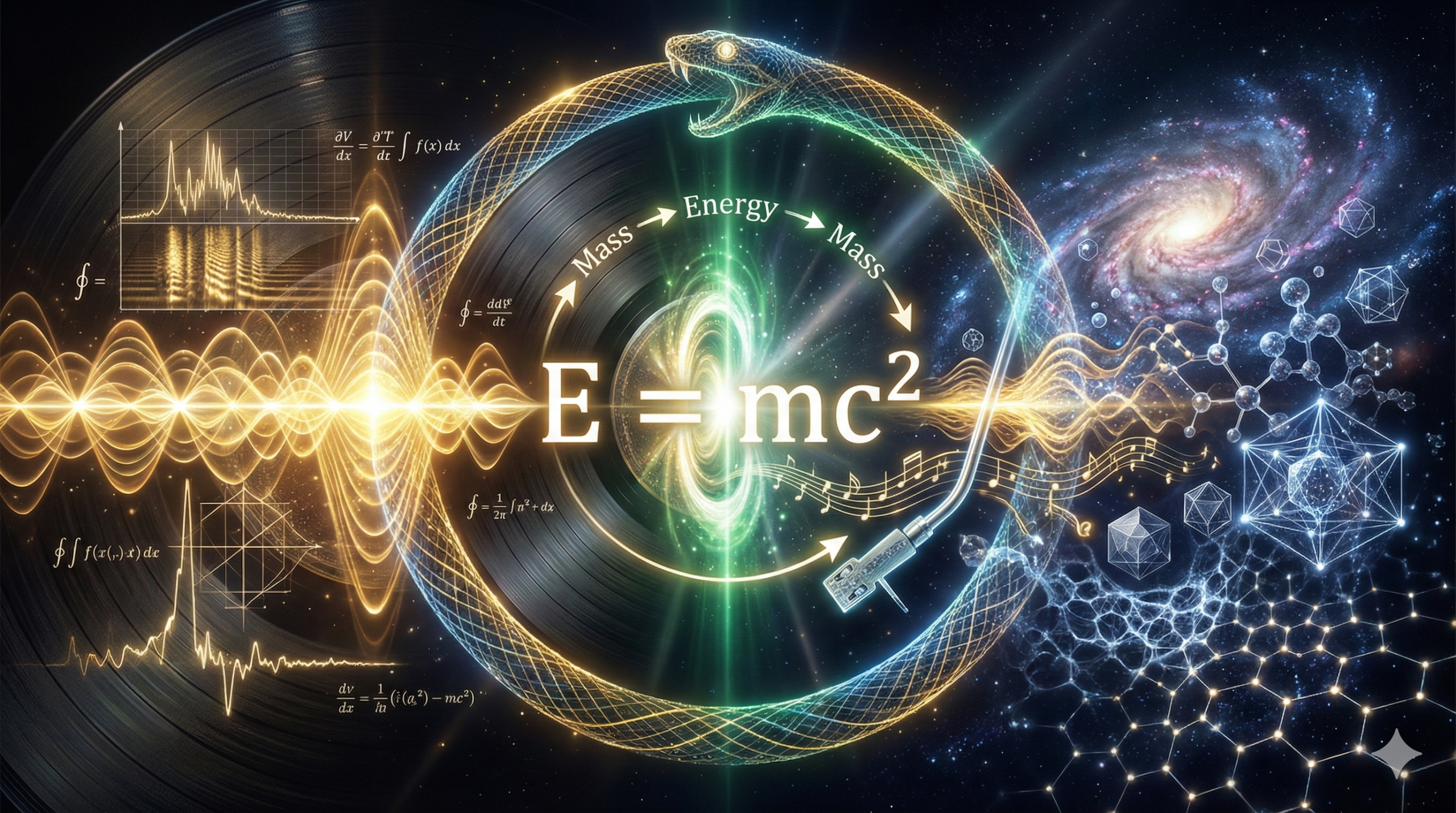
Conservation of Matter in an Eternal Framework: A M.E.T.A.-Physical Extension of the Eternality Axiom
The Eternality Axiom: A Compendium Paperback – January 2, 2026 (Amazon)
by Dr. Hakeem Ali-Bocas Alexander PhD (Author)
This companion paper extends the Eternality Axiom by formalizing the conservation of matter as a fundamental, non-contingent principle within an eternal reality. The First Law of Thermodynamics and Einstein’s mass-energy equivalence (\(E = mc^2\)) are co-eternal expressions of a single, indestructible substance. The integration of subquantum kinetics—Paul LaViolette’s Model G and etheron interactions—establishes a dynamic, sub-etheric field as the continuous mechanism for eternal transformation. Mathematically, Fourier and Inverse Fourier Transforms model the frequency-domain conversion between mass and energy, formalizing a cyclical view of manifestation. This paper synthesizes theoretical, mathematical, experimental, and applied pillars to establish matter as an eternal mode of the unified field.
Chapter 1: Introduction — Matter as Eternal Substance
1.1. The Contingency Fallacy in Modern Physics
Modern physics treats matter as a product of cosmic evolution—emerging from a singular beginning. The Eternality Axiom reframes matter as a fundamental, eternal aspect of reality. Matter is conserved across all scales and times, inseparable from the eternal field.
1.2. The Co-Eternal Axiom: \(E = mc^2\) and the First Law
The First Law of Thermodynamics states that energy cannot be created or destroyed. Einstein’s \(E = mc^2\) reveals mass as a concentrated form of energy. Together, they form a co-eternal principle:
Matter is a stable, localized excitation of the eternal energy field. The Big Bang represents a phase transition within an infinite substrate.
Chapter 2: Theoretical Pillar — Subquantum Kinetics and the Etheron Field
2.1. The Sub-Etheric Foundation: Paul LaViolette’s Model G
Subquantum kinetics posits a continuous, sub-etheric medium—the etheron field—composed of discrete units (etherons) whose interactions give rise to particles and forces. Model G describes a non-equilibrium thermodynamic system where etherons undergo reaction-diffusion processes, generating stable wave structures that correspond to particles.
2.2. Etheron Interactions as the Mechanism of Eternal Transformation
In this framework, mass and energy are interchangeable states of etheron organization:
- Mass: A coherent, stable etheron configuration (standing wave).
- Energy: A dynamic, diffusive etheron flow (traveling wave).
The etheron field is eternal and uncreated, with particles emerging as localized solitons within a boundless medium. This provides a mechanistic basis for the eternal conservation of matter.
2.3. Unification with Quantum Field Theory and Zero-Point Energy
The etheron field aligns with:
- Quantum Field Theory: The quantum field is the etheron field in a manifested state.
- Zero-Point Field: The ZPF is the ground state of the etheron field, teeming with potential fluctuations.
- String Theory: Vibrating strings are higher-order excitations of etheron structures.
Subquantum kinetics operationalizes the Eternality Axiom at a sub-particle level.
Chapter 3: Mathematical Pillar — Fourier Transforms and the Cyclical Conversion Model
3.1. Frequency Domain Representation of Mass and Energy
Mass and energy exist in complementary domains:
- Mass Domain: Localized, particulate structures in spacetime.
- Energy Domain: Delocalized, wave-like potential in the frequency realm.
The Fourier Transform (FT) and Inverse Fourier Transform (IFT) mathematically describe the conversion between these domains:
where \(m(t)\) represents a mass distribution in time, \(M(f)\) its frequency signature, \(E(f)\) an energy spectrum, and \(e(t)\) its temporal manifestation.
3.2. The Cyclical Conversion Theorem
Within an eternal framework, matter transforms. The conversion between mass and energy is cyclical and information-preserving:
This integral describes a closed loop of transformation within the eternal field, consistent with the First Law and \(E = mc^2\).
3.3. Quantum Wavefunctions as Fourier Superpositions
The quantum wavefunction \(\Psi(x,t)\) is expressed as a Fourier superposition of momentum states:
This formalism reinforces particles as wave-packets derived from an eternal frequency domain.
Chapter 4: Experimental and Applied Pillars — Empirical Validations and Technologies
4.1. Tabletop and Quantum Evidence
- Conservation of Mass in Chemical Reactions: Matter rearranges, never destroyed.
- Particle-Antiparticle Annihilation: Converts mass to energy, total field content remains.
- Quantum Random Number Generators: Harness vacuum fluctuations (etheron dynamics) to generate entropy.
4.2. Applied Technologies as Etheron Engineering
- Nuclear Reactors: Direct application of \(E = mc^2\), converting mass to usable energy.
- Quantum Sensors: Detect zero-point fluctuations, measuring the etheron field.
- Future Etheron-Based Technologies: Direct vacuum energy extraction and field-stabilized materials.
Chapter 5: Synthesis — The Eternal Cycle of Matter
5.1. The Unified View: Matter as a Mode of the Eternal Field
Matter is a persistent mode of excitation within the etheron field. Its conservation is guaranteed by the eternal structure of the field itself.
5.2. Implications for Cosmology and Metaphysics
- Cyclic Cosmology: The universe undergoes endless phases of expansion and condensation.
- Perceptual Boundaries: The Big Bang is a localized reification event within an infinite field.
- Metaphysical Continuity: Consciousness and matter co-arise from the same eternal substrate.
5.3. The M.E.T.A. Framework Revisited
- Mathematical: FT/IFT formalize transformation.
- Experimental: Conservation laws and quantum phenomena provide evidence.
- Theoretical: Subquantum kinetics supplies the mechanism.
- Applied: Technologies validate the model’s utility.
Chapter 6: Conclusion — Matter Without Beginning or End
The conservation of matter is an ontological necessity within an eternal reality. Integrating the First Law and \(E = mc^2\), subquantum kinetics and etheron dynamics, and Fourier-domain mathematical modeling establishes a rigorous, testable framework in which matter is eternal, transformative, and fundamental. This paper extends the Eternality Axiom, providing a foundation for a physics without temporal boundaries.
References
- LaViolette, P. A. (1985). Subquantum Kinetics: The Alchemy of Creation.
- Einstein, A. (1905). Does the Inertia of a Body Depend Upon Its Energy Content?
- Feynman, R. P. (1965). The Character of Physical Law.
- Planck, M. (1901). On the Law of Distribution of Energy in the Normal Spectrum.
- Dirac, P. A. M. (1928). The Quantum Theory of the Electron.
- Fourier, J. B. J. (1822). The Analytical Theory of Heat.
- ‘t Hooft, G. (1993). Dimensional Reduction in Quantum Gravity.
- Wheeler, J. A. (1990). Information, Physics, Quantum: The Search for Links.
Appendix A: Etheron Reaction-Diffusion Equations (Model G)
The governing equations for etheron density \( \rho \) in Model G:
where \( R(\rho) \) represents nonlinear reaction terms leading to pattern formation (particles).
Appendix B: Fourier Transform Derivation for Mass-Energy Conversion
Given a mass distribution \( m(x) \), its energy spectrum is:
This represents the eternal potential of mass in the frequency domain.

Also on ResearchGate – https://www.researchgate.net/publication/400544700_Conservation_of_Matter_in_an_Eternal_Framework